“Play is not just about having fun, but about taking risks, experimenting, and testing boundaries.” — American Academy of Pediatrics
One of the greatest joys of being a Pre-K teacher at Kids at the Creek is watching my students engage in safe, risky play. This year I am blessed to teach a unique group of fourteen little learners—nine boys and five girls. As you can imagine, they certainly keep me on my toes! What I have learned through many years in early childhood education is that risky play, although sometimes uncomfortable for adults, is essential for children’s growth.
What Is Risky Play?
Research identifies several categories of risky play for preschoolers. Safe risky play leads to big learning and acts as a natural experiment as children test their environment and their own abilities. Here are four types of risky play that my students engage in regularly:
- Great Heights (climbing)
- Rough-and-Tumble Play
- Power Play
- Destructive Play (play with impact)
Great Heights (Climbing)
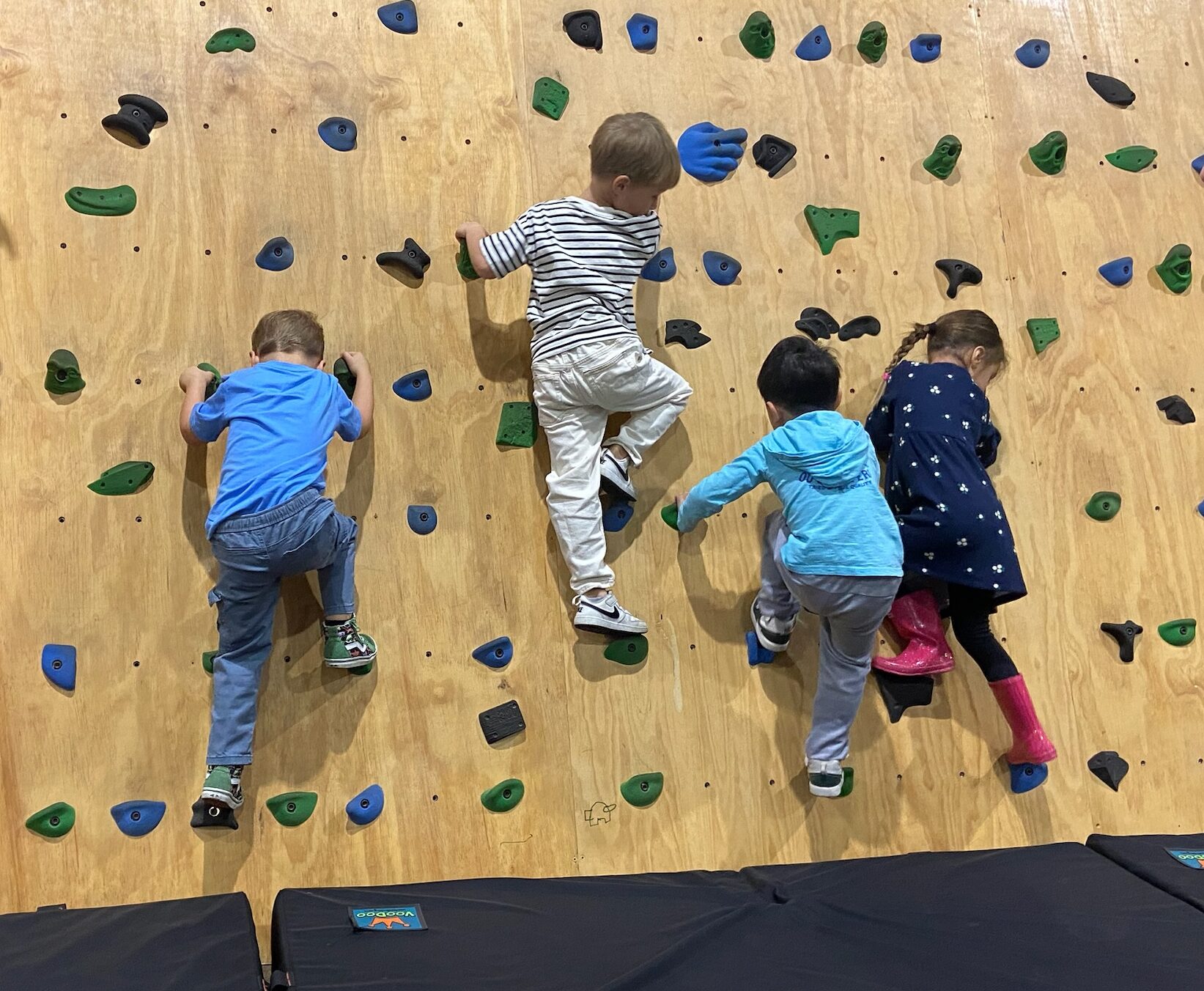
Risky climbing play teaches preschoolers important risk-assessment and decision-making skills. Children independently evaluate heights, distances, and their own physical limits. When your preschooler is climbing, they are using both the cognitive and executive parts of their brain. Climbing requires them to plan their next move, remember limb placement, and adapt to different environments. At Kids at the Creek, we love watching our brave preschoolers beam with pride as they master the climbing wall alongside their friends.
Rough-and-Tumble Play
Have you ever noticed your preschooler has a hard time keeping their hands to themselves? Rough-and-tumble play is actually an important part of development. During this kind of play, children are building social, emotional, and physical skills. While it may look chaotic to adults, children are learning how to balance competition with cooperation. They are also learning to read subtle non-verbal cues—like facial expressions and body language—which helps them tell the difference between playful and aggressive behavior.
Power Play
Power play happens when preschoolers explore feelings of strength, bravery, and control through play. On the playground at Kids at the Creek, both the boys and girls in my class enjoy this type of play. It may sound aggressive, but children are actually learning about fairness, boundaries, and managing big feelings. Power play can include pretending to be superheroes, roaring dinosaurs, zombies, or chasing each other while playing “good guys and bad guys.” Often, children are working through things they do not fully understand by acting them out through play.
Destructive Play
Crashing cars and trucks, knocking over towers, and taking things apart are examples of destructive play you might see in our classroom during free play. While the word destructive may sound concerning, this type of play helps preschoolers explore basic concepts of physics. Children are learning about gravity, motion, and cause and effect. By repeating these actions, they test the results of their choices again and again. When done safely, destructive play is an important part of learning and should not be viewed as bad behavior.
A Moment to Observe
The next time you are with your preschooler—at the playground, during a playdate, or at home—take a few minutes to simply observe how they are playing. Ask yourself if you can allow safe risky play without stepping in too quickly.
One study suggests following the “17-second rule.” If you start to feel uneasy about how your child is playing, pause and observe for 17 seconds before intervening. You might support their thinking by asking questions such as:
- “What’s your plan?”
- “How will you do that?”
- “Do you feel safe?”
- “What do you notice?”
Sometimes children just need a moment to test their ideas, solve problems, and discover what they are capable of doing.
When we allow children the space to climb, tumble, experiment, and try again, we are not just letting them play—we are helping them build courage, confidence, and the lifelong ability to face challenges with resilience.
Frequently Asked Questions: The Importance of Risky Play
1. What is “risky play” in early childhood education, and is it safe? According to Valerie Stiger, Director at KATC, risky play isn’t about putting children in danger; it is about “safe risky play.” This includes activities like climbing, rough-and-tumble play, and exploring heights. These acts serve as natural experiments where children test their physical limits and environment, helping them build essential risk-assessment skills in a supervised setting.
2. Why should I let my preschooler climb and explore “great heights”? When a child climbs, they aren’t just playing—they are using the cognitive and executive parts of their brain. Climbing requires a child to plan their next move, remember limb placement, and adapt to their environment. At Kids at the Creek, we’ve found that mastering a climbing wall helps preschoolers build decision-making skills and a deep sense of personal confidence.
3. Is rough-and-tumble play a sign of aggression in young children? Actually, it’s the opposite! Rough-and-tumble play is a vital developmental tool. It teaches children how to balance competition with cooperation and how to read non-verbal cues, such as facial expressions and body language. This helps them distinguish between playful interaction and actual aggression, building emotional intelligence.
4. What are the benefits of “power play” like pretending to be superheroes or “bad guys”? Power play allows children to explore feelings of strength, bravery, and control. Whether they are roaring like dinosaurs or playing “good guys vs. bad guys,” children use these scenarios to work through complex emotions and concepts they don’t yet fully understand. It is a safe way for them to learn about boundaries, fairness, and managing “big feelings.”
5. Why do children enjoy “destructive play” like knocking over towers? While it may look like “bad behavior” to adults, crashing cars or knocking over blocks is actually an early physics lesson. Through destructive play, preschoolers explore gravity, motion, and cause-and-effect. By repeating these actions, they are testing the results of their choices and learning how the physical world works.
6. How can parents support risky play without feeling anxious? Valerie Stiger recommends the “17-second rule”: if you feel uneasy about your child’s play, pause and observe for 17 seconds before intervening. Instead of stopping the play, ask supportive questions like, “What is your plan?” or “Do you feel safe?” This gives the child space to problem-solve and discover their own capabilities.